How to Back Up Windows 11: Windows Backup, OneDrive & File History Guide
A reliable Windows 11 backup is not just one switch you turn on. The right method depends on what you want to recover later: your personal files, your Windows settings and app layout on a new PC, or older versions of files stored on an external drive. For most home users, the easiest starting point is Windows Backup + OneDrive for important folders and supported settings, combined with File History or a separate external copy for files you cannot afford to lose.
One thing is especially important to understand: the Windows Backup app is not a full-disk clone or complete system image. It can sync selected user folders to OneDrive and save supported information such as installed-app references, Wi-Fi details, personalization, language, and other Windows preferences to your Microsoft account. File History serves a different purpose: it saves versions of files to an external drive or network location so you can recover something you deleted or overwrote. A good Windows 11 backup plan uses each tool for the job it is actually designed to do.
① Start Your Windows 11 Backup by Deciding What You Need to Recover
Before you configure anything, ask a simple question: What do I want to get back after something goes wrong? Moving your familiar Windows environment to a new PC, keeping an extra copy of important files, and recovering yesterday’s version of a document are three different backup goals.
| Backup goal | Recommended method | What it protects | What to remember |
|---|---|---|---|
| Restore your environment after reinstalling Windows or moving to a new PC | Windows Backup + OneDrive | Selected user folders, supported settings, app references/pins, Wi-Fi information, and other supported preferences | It is not a full system image, and some apps must be installed again |
| Keep versioned copies on another drive | File History | Libraries and supported personal folders with previous versions | Requires an external drive or network location |
| Quickly protect critical files before a reset or repair | Manual copy | The folders and files you choose yourself | It does not update automatically |
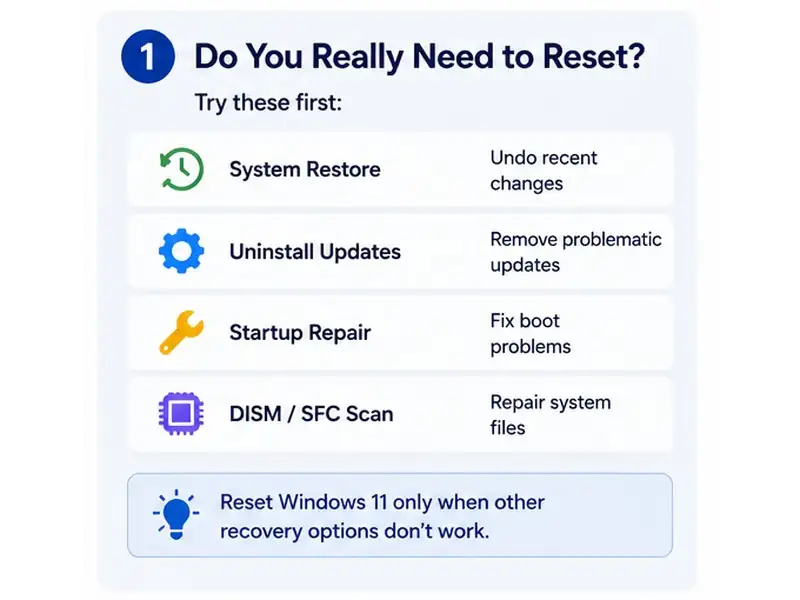
| Preserve a full-disk image or specialized system state | Legacy system-image tools or a dedicated imaging solution | Depends on the imaging method and selected volumes | More complex than the normal beginner backup workflow |
Do not expect one backup tool to cover every failure
A cloud-backed folder and a versioned external-drive backup solve different problems. If the files truly matter, keeping copies in different places makes your Windows 11 backup more resilient when one account, drive, or PC fails.
Related guide: How to Reset Windows 11 — Keep My Files, Cloud Download & WinRE Guide
② Set Up Windows 11 Backup First: The Best Starting Point for Beginners
The Windows Backup app is Microsoft’s built-in starting point for a consumer Windows 11 backup. It is designed around a personal Microsoft account and helps make a new PC or a fresh Windows installation feel more familiar by reconnecting backed-up folders, supported settings, and app information.
Microsoft currently states that the Windows Backup app is focused on consumer devices signed in with a personal Microsoft account. A work or school Microsoft account does not work with the consumer Windows Backup app in the same way, so organization-managed devices should follow their IT policy instead.
- Open Start and type backup.
- Select Windows Backup from the results.
- Sign in with your personal Microsoft account if Windows asks you to.
- Expand Folders and choose the user folders you want to protect through OneDrive.
- Review the available Apps and Settings backup categories.
- Do not stop at a “Backed up” label—open OneDrive and confirm that the files you actually care about have finished syncing.
You can also manage the same general Windows 11 backup configuration from Settings > Accounts > Windows backup. Microsoft currently lists Desktop, Documents, Pictures, Videos, and Music as user folders that Windows Backup can connect to OneDrive.
Microsoft: Back up and restore with Windows Backup
Windows Backup is strongest when you are setting up a new PC again
During setup after a reinstall—or when moving to a new Windows PC—signing in with the same Microsoft account can offer a previous backup to restore. App pins can return, supported settings can be restored, and OneDrive files become available again. Apps themselves are not simply cloned: Store apps can be reinstalled from their restored pins, while non-Store apps may send you to the web for an installer.
③ What Does Windows Backup Actually Save?
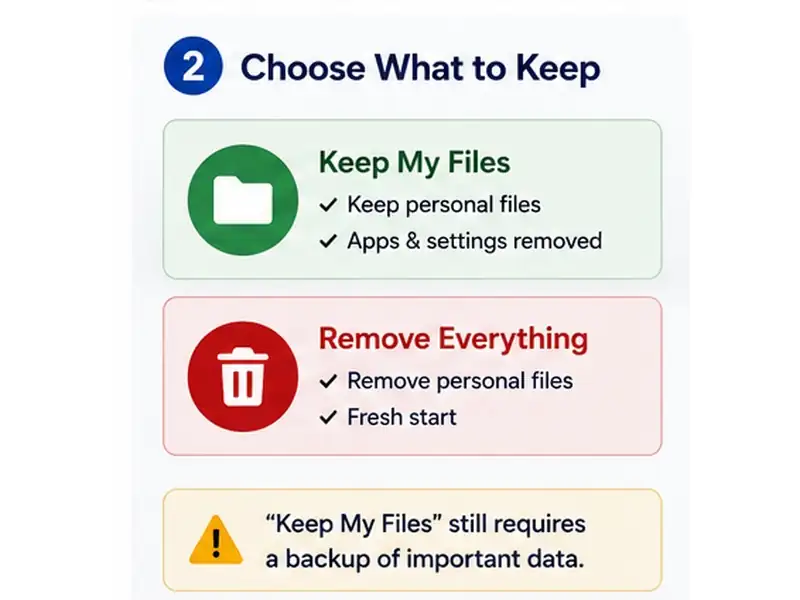
People often hear “Windows Backup” and assume it means a complete copy of the PC. It does not. The modern Windows 11 backup experience is mainly about combining selected files with Microsoft-account-based recovery information so you can rebuild your familiar environment more quickly.
| Item | How Windows Backup handles it | What happens during restore |
|---|---|---|
| Personal files | Selected user folders are synchronized to OneDrive | Sign in to OneDrive with the same Microsoft account to access them again |
| Installed apps | Windows stores app references and supported app-pin information | Store apps can be reinstalled from their pins; non-Store apps may require a fresh installer |
| Windows settings | Supported accessibility, account/Wi-Fi, personalization, language, and other Windows settings can be synchronized | Supported settings return, but not every setting inside every program is recreated |
| Browser data | Edge sync is managed separately from Windows Backup | Favorites, passwords, and other browser data depend on the browser’s own sync configuration |
Important: do not assume that Downloads, a custom work folder, a project folder on D:, or application-specific local data is automatically included in your Windows 11 backup. Before a reset or reinstall, check the folders you actually use rather than relying on folder names alone.
④ Use OneDrive Folder Backup for Cloud Protection
If OneDrive is part of your Windows 11 backup plan, you can manage protected folders directly from the OneDrive settings.
- Select the OneDrive cloud icon in the Windows notification area.
- Open Help & Settings, then Settings.
- Open the Sync and backup tab.
- Select Manage backup.
- Turn on the folders you want to protect and save the change.
Be careful when you stop OneDrive folder backup. A folder can contain cloud-only files that are visible in File Explorer but are not currently stored as full local copies. Microsoft specifically warns that you may need to download those files first by changing them to Always keep on this device before moving them back to a local-only folder.
Microsoft: Back up your folders with OneDrive
⑤ Add File History If You Have an External SSD, HDD, or Network Location
File History is useful when you want your Windows 11 backup to include previous versions of changing documents, photos, and other personal files on storage that is separate from your cloud account. It saves versions to an external drive or network location and lets you go back to an earlier copy when a file is deleted, damaged, or overwritten.
- Connect the external SSD/HDD you want to use, or make sure the network backup location is available.
- Open Control Panel.
- Go to System and Security > File History.
- If Windows has not selected the correct destination, choose Select drive.
- Select Turn on.
- Review the available advanced settings if you want to adjust how frequently versions are saved or how long they are kept.
Microsoft currently explains that File History automatically protects libraries such as Documents, Pictures, Videos, and Music, and its guidance also references essential folders such as Desktop. If an important folder lives somewhere else—such as a custom project folder on another drive—add it to a library or otherwise verify that it is actually inside the File History scope. Do not assume a custom D: folder is protected just because File History is turned on.
Microsoft: Backup and restore with File History
The real advantage of File History is version recovery
A manual copy usually gives you only the version you copied. File History can keep multiple points in time, which is useful if you accidentally overwrite a document or realize that yesterday’s version of a project was better than today’s.
⑥ Restore an Older File Version with File History
A Windows 11 backup is only useful if you can restore from it. If File History is already configured, Microsoft’s current restore workflow is straightforward.
- Open File Explorer and go to the folder that originally contained the file or folder you want to recover.
- Right-click the folder and select Restore previous versions.
- Choose the version from the date you need.
- Use Open or Open in File History to inspect it first when appropriate.
- If the current file matters, use Restore to… and restore the older version to another location instead of immediately overwriting the current one.
Microsoft warns that using the normal Restore action replaces the current version and that the replacement cannot simply be undone. For an important file, restoring to a different folder first is usually the safer way to verify what you recovered.
⑦ Need a Fast Backup Before a Reset? Manual Copy Is Still Valid
If you have to reset, repair, or hand over the PC soon and do not have time to build a new automated Windows 11 backup system, manually copying the important data to an external SSD or HDD is still a valid emergency step. Just remember that a manual copy is a snapshot: it does not update itself after you make the copy.
| Where to check | Typical files | Easy-to-miss items |
|---|---|---|
| Desktop | Documents, exported work, temporary project folders | Original files left inside a temporary desktop folder |
| Documents | Office documents, PDFs, project files | Application-created subfolders |
| Pictures and Videos | Photos, recordings, exported media | Original source media that was stored separately from exports |
| Downloads | Downloaded documents, installers, attachments | Files that are difficult or impossible to download again |
| Custom work folders / D: drive | Editing projects, source code, business files | Data stored outside the standard Windows user folders |
Related guide: How to Reset Windows 11 — Keep My Files, Cloud Download & WinRE Guide
⑧ Do Not Keep the Original and Backup on the Same Physical SSD
Copying files from C: to D: can feel like a backup, but it may not protect you from a hardware failure if both partitions are on the same physical SSD. A single SSD failure can take both the original and the “backup” with it.
For important data, put at least one Windows 11 backup copy on a physically separate device or in the cloud. A simple way to think about this is the familiar 3-2-1 backup idea: keep multiple copies, use more than one kind of storage, and keep at least one copy away from the computer itself. You do not need an enterprise backup system to benefit from the principle.
⑨ When Does a System Image Make Sense?
Windows still exposes older system-image and recovery components in places such as Backup and Restore (Windows 7), and Windows recovery tools can still work with system images. But a full-disk image is a different category from the everyday Windows 11 backup described in this guide.
If your goal is simply to protect documents and photos, restore previous file versions, and make a new PC easier to set up, start with Windows Backup, OneDrive, and File History. Full-disk imaging is more appropriate when you deliberately need a restorable machine state and are comfortable managing image creation, storage space, bootable recovery media, and the limits of the imaging tool you choose.
⑩ Test Your Windows 11 Backup Before You Trust It
The most common backup mistake is assuming that “enabled” means “recoverable.” A Windows 11 backup can quietly fail because the OneDrive account ran out of space, an external drive was disconnected, a custom folder was never included, or synchronization stopped.
- OneDrive: open OneDrive on the web or another device and confirm that a recent test file is actually there.
- File History: restore a test file or previous version to a different location.
- External drive: open several backed-up files directly and make sure they are readable.
- Capacity: confirm there is enough storage for the data you intend to protect.
- Recency: check that the most recent backup or sync time matches your expected schedule.
A backup is not finished until a restore test succeeds
Restoring one harmless test file teaches you where the backup is stored, how long recovery takes, and whether the backup actually contains what you expected. Finding that out before a reset or SSD failure is far better than discovering the gap after the original files are gone.
⑪ Final Backup Checklist Before a Reset or Windows Reinstall
- Check Desktop, Documents, Pictures, Videos, and other user folders you actively use.
- Review Downloads for files that may be difficult to obtain again.
- Check D: and any custom work/project folders outside your standard profile.
- Confirm browser favorites and password synchronization if you rely on it.
- Check local databases, project files, game saves, or application-specific data that may not live in normal user folders.
- Save certificates, license details, recovery codes, and other information that may be difficult to recreate.
- Confirm OneDrive synchronization has actually finished.
- Open at least one or two files from the external backup.
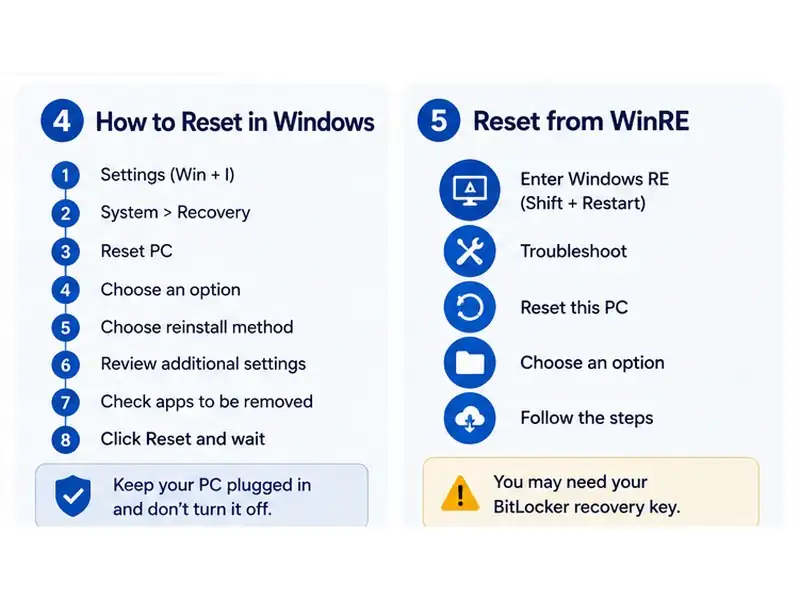
- If the PC uses BitLocker, make sure you can access the recovery key before resetting or reinstalling Windows.
If the PC is already having problems: Windows 11 Recovery Guide — Fix Boot Errors with WinRE & System Restore
If you need to reinstall Windows: How to Install Windows 11 — USB & Clean Install Guide for Beginners
❓ Windows 11 Backup FAQ
Q. Does Windows Backup create a full backup of the entire PC?
A. No. Windows Backup can protect selected user folders through OneDrive and save supported settings, app information, and other preferences to help you rebuild your environment. It is not the same as a full-disk image or clone.
Q. Will all my programs automatically come back after a Windows Backup restore?
A. Not exactly. Microsoft restores app pins and related information. Microsoft Store apps can be reinstalled from their restored pins, while non-Store apps may require you to download and run their installers again.
Q. Should I use OneDrive or File History?
A. They solve different problems. OneDrive is convenient for cloud protection, synchronization, and accessing selected folders across devices. File History is useful for keeping previous versions on an external drive or network location. For important data, using both can make a Windows 11 backup strategy more resilient.
Q. Is the Downloads folder automatically included in Windows Backup?
A. Do not assume it is. Microsoft’s Windows Backup documentation currently lists Desktop, Documents, Pictures, Videos, and Music as folders you can back up through the app. Check Downloads separately and manually copy anything important before a reset or reinstall.
Q. Should I leave an external backup drive connected all the time?
A. It depends on your backup routine. An always-connected drive makes frequent automatic backups convenient, but it can also be exposed to some of the same malware, accidental deletion, or electrical events as the PC. Some people prefer to connect the drive for scheduled backups and disconnect it afterward.
Q. What should I back up first before resetting Windows 11?
A. Start with data that is difficult or impossible to recreate: personal documents, photos, work files, project folders, custom D: drive data, and important downloads. Then verify browser sync, application data, licenses, recovery codes, and the BitLocker recovery key.
Final Thoughts: A Windows 11 Backup Is Only Useful If You Can Restore It
You do not need an overly complicated backup system to protect a normal Windows PC. For a straightforward Windows 11 backup, start with Windows Backup and OneDrive so important folders and supported settings are connected to your Microsoft account. If you have an external SSD, HDD, or network location, add File History for previous versions of important files.
Before a reset or reinstall, do not rely on automation alone. Check Desktop, Documents, Pictures, Downloads, custom project folders, and any data stored outside your normal Windows profile. Then restore one test file and make sure it opens correctly.
The real measure of a good Windows 11 backup is not whether Windows says “Backed up.” It is whether you can recover the file you need, from the copy you expected, when the original is no longer available.
Next in the series: Windows 11 Update Guide — A Practical Step-by-Step Walkthrough for Beginners